
Disinfection and sterilisation of medical devices
From receipt of your parts to final packaging, we carry out inspection, cleaning, disinfection, sterilisation and preparation in line with your requirements and following your protocols.
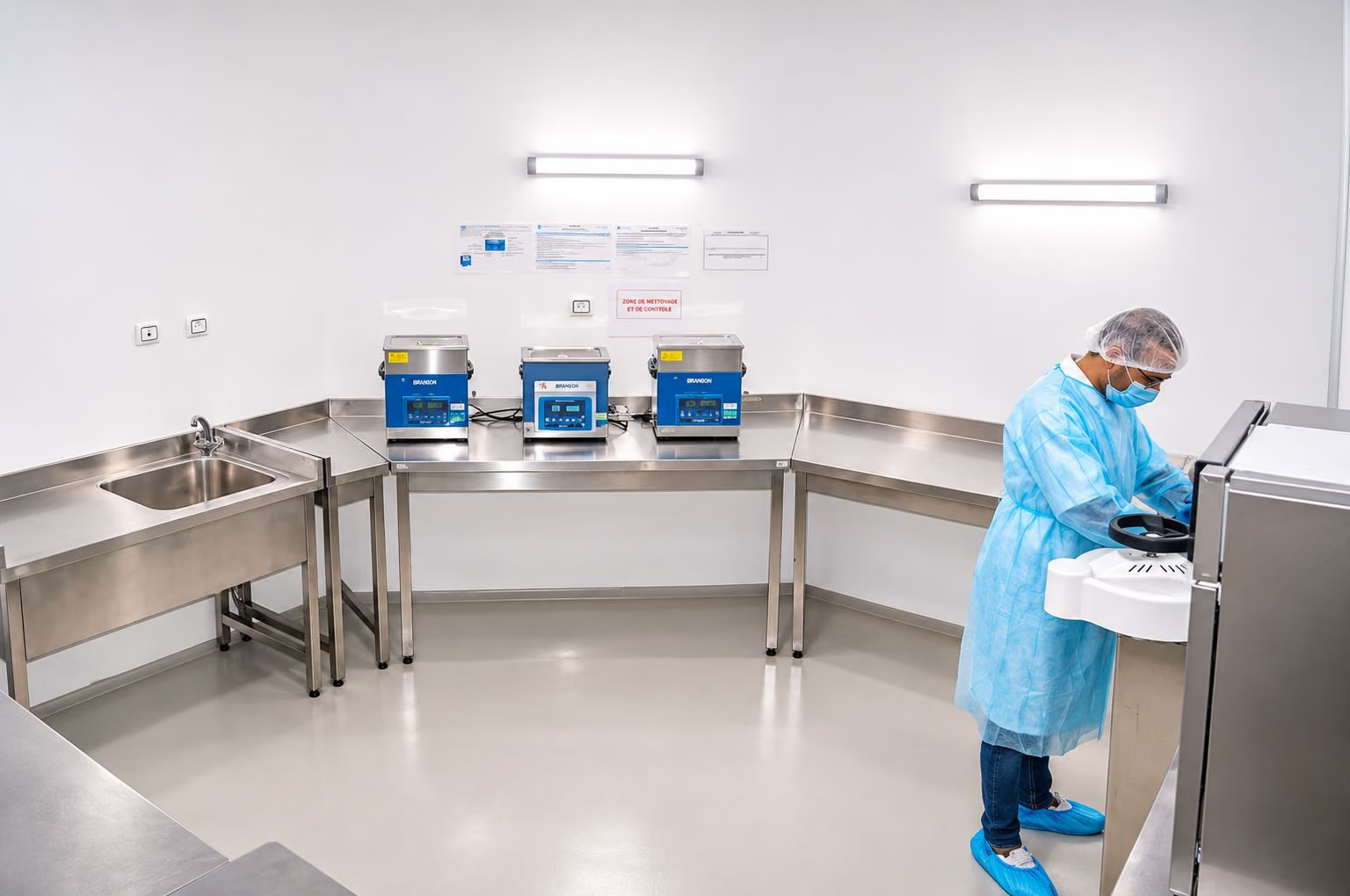
Your protocol sets the method and we apply it
We disinfect and sterilise medical devices in line with our customers’ requirements and following their protocols. You define the process, its parameters and your acceptance criteria. We apply that protocol to your parts.
The manufacturer knows the material of its device, its geometry and its use, and so chooses the compatible process.
Before any trial, we check with you that your protocol can be applied at our facilities.
Cleaning comes before disinfection and sterilisation
Disinfection or sterilisation acts on the surfaces it reaches. If manufacturing residues cover them (oil, dust, particles, mould-release traces), they shelter micro-organisms and slow the action of the agent. Cleaning therefore comes first.
On receipt, your parts are inspected, then cleaned following your protocols. A cleaning protocol usually specifies the product, its concentration, the contact time, the temperature, rinsing, drying and the expected cleanliness criterion. These parameters come from you. We apply them in our preparation area, and their execution goes into the batch record.
Disinfection lowers the count, sterilisation aims for none
Disinfection reduces the number of micro-organisms on a surface to a defined level. Sterilisation aims at the absence of viable micro-organisms. A device presented as sterile must stay sterile until it is used, which ties sterilisation to packaging.
The level required depends on how the device is used: contact with intact skin, a mucous membrane or tissue. Your file sets it, and we carry out either operation in line with your requirements.
Depending on the device, sterilisation takes place before or after the device is packaged. Your protocol states which. We organise the primary and secondary packaging accordingly.
An ISO 8 cleanroom is dedicated to packaging
We have an ISO 8 (Grade D) cleanroom dedicated to packaging. A separate area handles secondary packaging. These operations follow your protocols.
An ISO 8 room limits the concentration of airborne particles during operations. The sterility of a device depends on its process and its packaging. Our guide to the ISO 8 cleanroom explains what this class covers.
Only one batch is handled at each workstation, to prevent mix-ups. Work in progress and finished products are stored separately.
A batch record follows your devices through to shipment
Every batch is documented through to shipment. Checks take place on receipt, during production and before release. A certificate of conformity is included with each delivery.
An external laboratory calibrates our measuring equipment. Regular microbiological checks are also carried out by an external laboratory. You can verify these practices on site: we host customer audits, in addition to our internal and certification audits. The page on quality and batch traceability sets out all of these checks.
Your written protocols are the basis for the first batch
To review your project we need:
- your cleaning protocol: products, parameters, cleanliness criterion
- your disinfection or sterilisation protocol, with its acceptance criteria
- a description of the parts and their condition on arrival (transport packaging, identification, batch)
- the packaging expected after treatment
- the checks and documents expected with each delivery
- your volumes and shipment frequency
Questions about sterilising medical devices
Which sterilisation method do you use?
The one your protocol specifies. State it in your request: at the project review, before any trial, we will tell you whether our facilities can apply it.
How do you handle our parts when they arrive?
We inspect them on receipt, then clean, disinfect or sterilise them following your protocols before they are packaged. We will review their origin and their condition on arrival with you.
What does your ISO 13485:2016 certification from DQS cover?
Our quality management system is certified to ISO 13485:2016 by DQS for the manufacture, quality control, storage and sale of non-sterile dental medical devices. This scope covers non-sterile devices: disinfection and sterilisation are not part of it.
We also study manufacturing and packaging projects for other medical devices. Every batch keeps its record. Every delivery ships with its certificate of conformity.
What microbiological checks are carried out?
An external laboratory carries out regular microbiological checks. Checks specific to your product belong in your specification: we will look at how to organise them at the project review.
We read your protocol before the first part
Send us your cleaning, disinfection or sterilisation protocols: we will check with you how to apply them to your devices.