
Medical injection moulding of small precision parts
We mould small precision parts for medical device manufacturers. Trimming, finishing, pad printing and technical packaging complete the moulding.
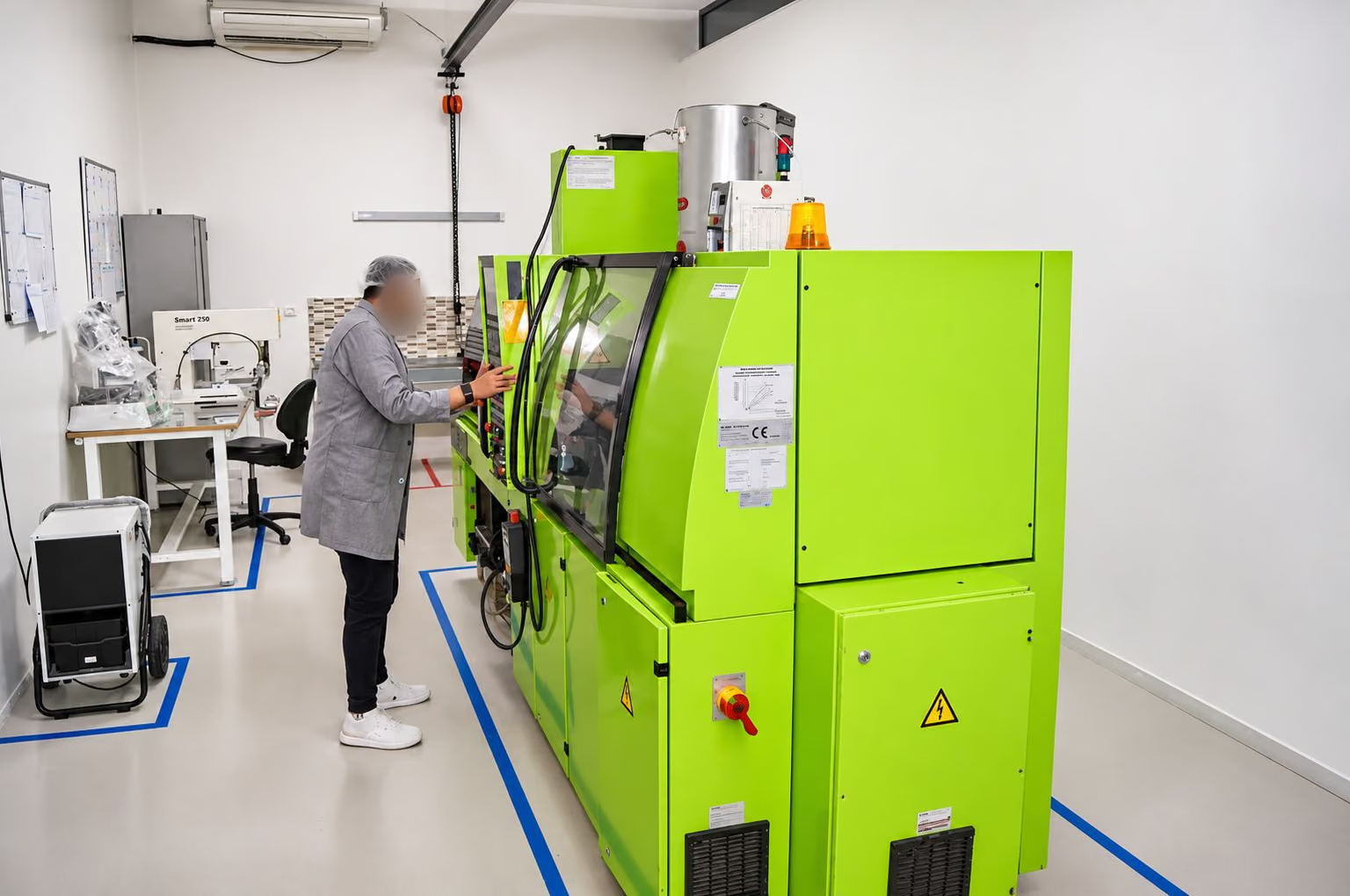
The mould sets the precision of your parts
Frégate is a contract manufacturer of small precision parts made by medical injection moulding. We start from your drawings, advise on material choice and develop the tooling with you before series production begins.
In injection moulding, molten material is pushed under pressure into a closed mould, where it cools before the part is ejected. On a small part, the dimensions are decided in 2 places: the mould cavity and the press settings (material and mould temperature, pressure, holding time, cooling).
Once the mould and the settings are validated, every cycle repeats the same geometry, within tolerance. That is why a project begins with trials.
Our precision dental parts have their own page.
PEEK and engineering plastics, chosen to match your specification
We mould engineering plastics, including PEEK. PEEK (polyetheretherketone) is a semi-crystalline, high-performance thermoplastic: it keeps its mechanical properties at high temperature and resists many chemicals. It is found in medical parts that must stay rigid and stable over time.
It takes more care to process than a commodity plastic. The pellets are dried before moulding, the material is injected at high temperature, and the mould temperature sets the crystallinity of the part, and so its mechanical strength. A mould designed for another material is not always suitable: shrinkage on cooling differs from one material to the next and shifts the dimensions.
The material is chosen from the function of the part, any contact with the patient and the cleaning the device will undergo. Where the part touches the patient, the choice rests on the biological evaluation of the device. That evaluation is the manufacturer’s responsibility and is framed by ISO 10993-1.
Trimming and finishing criteria are set at the project review
A moulded part rarely leaves the mould ready to use. The sprue and gate often have to be removed, a parting line deburred, or a dimension or surface finish reworked.
We carry out trimming and finishing. These operations are defined at the project review, together with their acceptance criteria: appearance, tolerated flash, areas not to be touched. They then go into the batch record, like the moulding itself.
From moulding to pad printing, your small parts have one point of contact.
Pad printing marks the curved surfaces of small parts
Pad printing transfers ink from an engraved plate to the part with a silicone pad. The pad conforms to the shape. It is a common way to apply a graduation, a reference mark or a logo to a small plastic part, even a domed one.
We pad print after moulding, trimming and finishing. On a medical device, 3 points are settled before the series. The ink must adhere to the material. It must withstand the cleaning and disinfection planned for the device. If it touches the patient, it forms part of the device’s biological evaluation. The principle, the inks and the marking checks are covered in our guide to pad printing for medical devices.
Tubes, cases and boxes made and marked to fit your parts
We make and mark technical packaging: tubes, cases and boxes that protect and present products. Their shape, closure and marking are designed around the part they hold.
Giving the part and its packaging to the same contact means you do not have to align 2 suppliers on the same tolerances. The technical packaging can then be combined with the primary and secondary packaging of your devices, if you also entrust that packaging to us.
From prototype to series in 4 steps
Our method has 4 steps: needs analysis, trials and validation, production and control, shipment. For a moulded part, the analysis covers the material and the mould. The trials cover prototypes, tooling development and first parts, which you approve before the series.
Each production batch is then documented in a batch record from raw material to shipment, with checks on receipt, during production and before release. We ship to Europe regularly, and every delivery goes out with its certificate of conformity. Our method page describes these steps, from needs analysis to shipment.
What we need to review a moulded part
To review a part we need:
- your 2D and 3D drawings, with tolerances and critical dimensions
- the target material or grade, or failing that the function and environment of the part
- your annual volumes and batch sizes
- the trimming and finishing operations expected
- the marking: content, position, ink colour
- the technical packaging and device packaging expected
- the existing mould, if there is one
Tell us about your project with these elements, even if incomplete: the review will help us define the rest.
Questions about contract injection moulding
Can you assess an existing mould?
Describe the mould and any production history you hold: we will tell you how to send us its drawings. At the project review we will examine its condition and its compatibility with our presses and the intended material.
Who owns the tooling?
Our moulds are made by a toolmaker and stored on our site. Ownership of the mould and its maintenance are settled at the project review, before tooling starts.
What does your ISO 13485:2016 certification from DQS cover?
Our quality management system is certified to ISO 13485:2016 by DQS for the manufacture, quality control, storage and sale of non-sterile dental medical devices. This wording refers to non-sterile dental medical devices only.
We also study manufacturing and packaging projects for other medical devices. In both cases every batch has its record and its checks. Every delivery ships with its certificate of conformity.
What quantities do you produce?
From prototype to series production: we make the prototypes, develop the tooling, then produce in series to suit your volumes. Give us your annual quantity and batch size: the production rate and organisation will be defined at the project review, according to the part and its tooling.
An injection moulding review starts with your drawings
Describe your part and specification: we will review the material, the tooling and the finishing operations with you.